Nourishment and Witness: On Reading Rachel Turney's “Women Making Soup Together”
Review by Candice M. Kelsey
Yield:
Enough to feed a body, a lineage, a resistance.
Time:
As long as it takes. Generations, maybe. Or just one afternoon in the kitchen.
Ingredients:
Women’s voices
Labor
Hunger
Art
One communal pot
Preparation:
Begin by gathering. This collection insists on the collective. Women Making Soup Together (Vinegar Press, Pueblo, Colorado) is a poetry collection that understands creation as an act of assembly: bodies, histories, skills, and words brought into one shared space. From its title forward, Rachel Turney positions the kitchen as a site of strategy, memory, and endurance.
These poems are concerned with women’s labor, vulnerability, and creativity, but they refuse abstraction. They are grounded in physical acts: chopping, stirring, shopping, lifting, watching, waiting. The domestic is rendered as a place where power and survival are negotiated.
Turney’s language is direct and incantatory. She understands that clarity itself can be a radical gesture, particularly when describing women’s experiences that have been historically minimized, aestheticized, or ignored.
Stock:
Every soup depends on its base. In this collection, the stock is made from repetition, inheritance, and shared knowledge. Turney’s poems return to what women pass down to one another: recipes, warnings, songs, skills, and language.
In “Nourishment for Battle,” the speaker addresses the unspecified and expansive you:
Thank you for your porcini slices, they have a place here.
The gratitude is specific. Each contribution is named and valued. Even the smallest offering—“one dirt-covered potato,” “a sprig of thyme”—is welcomed. What I appreciate most is that this poem resists hierarchies of usefulness. And here is where Turney’s message steams warmest from the tureen, declaring everything belongs in the pot.
Also crucially, the poem refuses to separate artistic labor from physical labor:
Bring your / pens and paper. Bring your / instruments of art. Bring your / words and pour them into my stock pot.
Here, language is folded into the culinary. Turney once again urges that art is not an escape from embodied life but a continuation of it. This is one of the collection’s central claims: that women’s creativity has always existed alongside survival work, and that the division between “art” and “domestic labor” is a false and gendered one.
Method:
Chop finely. Precision matters. Turney’s poems attend carefully to detail without losing momentum. The shaved carrots and pearl onions accumulate texture.
Stir continuously. The poems move in cycles rather than straight lines. They return to themes of care, threat, and endurance, deepening rather than repeating.
Share the labor.
We will take turns stirring. Our muscles have grown so / strong.
Strength here is literal. The poem refuses the trope of women as passive nurturers; these women have calluses. They are physically capable. Practiced even.Season with memory.
I hum the same songs that / I have heard other women in the kitchen . . . / I recite their poems and their axioms.
The kitchen is a site of oral history, where women’s voices echo and overlap.Do not skim the surface.
I do not catch my tears as they / fall.
Emotion is not removed for clarity; it is essential. The tears are part of the recipe.
Heat:
If “Nourishment for Battle” establishes the collection’s communal ethos, “Grocery Shopping” introduces the heat.
Turney exposes how even the mundane environment of a grocery store is charged with threat. The speaker is reduced, surveilled, and sexualized while performing an act of self-care:
i am made to feel that i am not a person / worth being a person.
The poem’s power lies in its refusal to escalate artificially. There is no dramatic confrontation. Instead, there is staring. Watching. Waiting. The violence is ambient, systemic, and persistent.
The can of chicken noodle soup becomes a central object of comfort and a potential weapon:
The can of soup is pretty hefty and might / work if used to bludgeon.
The poem articulates a grim reality many women recognize: the constant assessment of whether one’s body is strong enough to survive an encounter that should never occur.
The brilliance of this poem is its restraint. Turney does not editorialize. She allows the thought process itself to indict the culture that produces it:
i wonder how many women have stood in the checkout / line being ogled…
The answer is both obvious and devastating. As is her play on the word “checkout.”
Simmer:
The title Women Making Soup Together suggests warmth and abundance, but the book never lets us forget that soup is also a survival food. It is what we make when resources are scarce, when we need to stretch what we have, when we must feed many, including ourselves.
Turney understands this duality. Her poems acknowledge joy without denying danger, and solidarity without erasing isolation. Even in moments of collective strength, there is an awareness of vulnerability:
Taste and Adjust:
One of the collection’s most striking gestures appears in the line:
Please let me know when i can capitalize i again.
The lowercase i becomes a visual representation of diminishment, of erasure by systems of power. The desire to reclaim capitalization is the desire to reclaim personhood.
Serving Suggestions:
Women Making Soup Together is a book best read slowly, perhaps aloud, perhaps in the company of others. It would pair well with conversation, with shared meals, with classrooms, with community spaces. It belongs in feminist literary conversations, but it does not require theoretical scaffolding to be understood. Just a willing spoon.
The pot is large. There is room for everyone who brings what they have.
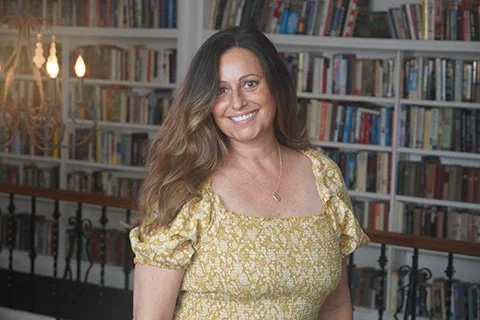
Candice M. Kelsey (she/her) is a bicoastal writer and educator. Her work has received Pushcart and Best of the Net nominations, and she is the author of eight books. Her work appears in Bust, The Rumpus, Painted Bride Quarterly, Poet Lore, SWWIM, and other journals. A reader for The Los Angeles Review and The Weight Journal, she recently served as an AWP poetry mentor.