Packing Up Books at Gotham Book Mart
by Erik La Prade
From A Fabulous Mess: The Last Days of Gotham Book Mart
I. Recruited
Just before the sale of the building housing Gotham Book Mart, during the second week of June 2004, I visited Gotham, looking for a particular magazine called Neurotica, a pre-beat periodical published in 1950. Only nine issues were ever published, and issue six contained Alan Ginsberg’s first published poem, “Song.” I owned two copies of issue six, but I was looking for issues one, two, and three.
Philip Ahrens, or “Flip” as most customers called him, was the gatekeeper of the basement, where various small magazines were stored. I told Flip what I was looking for, and he quickly disappeared into the basement and returned five minutes later with issues one, four, and seven. I bought issue number one. During a conversation with Flip, he mentioned that the store was being moved and that he was hiring people to pack boxes. He wanted to know if I was available to work and offered to pay me fifteen dollars an hour. I said, “Sure.” Flip’s offer to work was welcome. I had been working as a substitute teacher, and the school year had just ended, so I was unemployed. Since the actual packing up was scheduled to begin the following week, I called Flip a week later, and he informed me they were still waiting for the real estate lawyers to close the deal and give them the go-ahead signal. Another week passed; I again called Flip, and he told me to come in the next day. I started working at Gotham on Saturday, June 19, 2004. I wasn’t thinking about Gotham’s history, the consequences of this move, or what it meant to go from being a customer to an employee at Gotham. I only knew I was about to start working in an old building that had no air conditioning.
II. Packing Up, Floor by Floor
I arrived at Gotham about eleven o’clock on Saturday morning. Most of the regular Gotham employees were already at work. Flip had also hired several co-eds: two from Yale University and three from Columbia University. It was a very literate group doing a messy job. We were assigned to a particular area on an upper floor. We worked in groups of two or three. Everyone got a few sheets of color-coded dots, a roll of industrial tape, and a stack of boxes. Flip had devised a system for packing and color-coding boxes so the movers would know what floors these boxes were to be moved to.
A black dot might indicate a box containing rare books or collectibles and should go to the first-floor office to be placed in the safe. Red dots indicated a box containing general books that should be moved to the second floor of the new building. Pink and orange dots were film books or magazines that needed to be placed on the fourth floor. Plus, we had to write a word or two on the outside of each box, describing the contents.
Andreas Brown, or AB, the owner of Gotham, was constantly worried that we were doing things incorrectly. Brown’s daily complaint or mantra was “Common sense!” He invoked this phrase whenever he saw or caught anyone mislabeling a particular box or packing books incorrectly. After delivering his “Common sense!” remark, Brown would lecture the culprit on how it would behoove him or her to be more careful and pay attention to what they were doing. Doing a sloppy packing job meant rare and important books or materials could get lost or, worse, damaged beyond repair. Moving the first floor was a pretty straightforward affair. The book sections were all labeled by subject matter, making it easy to transfer the books directly from their area into a box with the title of that area written on it. The first floor of the new building was reserved for new books: nothing used or secondhand. The secondhand fiction was fated for the second floor, where customers could browse it to death. The back room on the second floor was supposed to be a rare-book room, where first-edition fiction and poetry books would be shelved.
The second floor of the old Gotham building consisted of the Gallery, where art exhibitions (mainly shows of Edward Gorey’s work), book signings, and parties had been held. Behind the Gallery was a large storeroom, with shelves where some of Gorey’s personal and estate materials were shelved in cardboard boxes. There were also stacks of film-and-literary magazines, framed pictures, and artworks. The storeroom itself had 1920s lighting fixtures, black and gray windows facing the back area, and fifteen-foot-high ceilings. Open stacks of magazines filled the shelves. Sometimes, the magazines were stored in boxes, labeled with the journal’s name, volume number, and whether it was a complete or incomplete run written on a weathered index card, taped to the side of the box. If the box was in good condition, we’d put a colored dot on all four sides and remove it to the hallway to be moved downstairs. If the box was falling apart, we’d have to repack the contents in a new box.
There was another room within this large storage room. It was the film room. Here, I found complete sets of Film Culture, Sight and Sound, and other film magazines and film books. Some of the film books in this room were: High Anxiety by Mel Brooks, I Am Curious Yellow, I Was Curious Yellow (The Making of I Am Curious Yellow), The Complete Greed of Erich von Stroheim, as well as Green Pastures, Goodfellas, Gone With the Wind, Around the World in 80 Days (Michael Todd’s 1956 version), When Jackie Chen Was Still Learning Wheel Kicks, A Nous la Liberte and Entr’acte by René Char, and many others. And She Lives,a screenplay by Elizabeth Gill, based on a novel by Paul Neimark. Plus, close to a hundred copies of the paperback screen book of Easy Rider!
While I was taking a break, I began a conversation with one of the co-eds from Yale. She didn’t know New York very well, so I offered to show her around. Just as she gave me her phone number, the owner walked into the room and asked me to work in a different area. It was a short-lived bookstore romance.
One of my first official moving projects as directed by Brown was boxing up his collection of Interview magazines. This collection was located in a loft area above a large safe in the second-floor gallery. In this loft space I found four dozen black-plastic bags, each filled with multiple issues of Interview magazine. Brown said he had bought large numbers of each issue as they were published. He had copies starting with the first issue and continuing to the magazine’s fifth year of publication. Most of these magazines were in perfect condition, and it looked like none had been handled in the past twenty-five years.
I collated all the issues, putting them into chronological order from 1969 to 1975. After I boxed them up, the gallery space was now filled with approximately forty boxes of Interview magazines. Brown told me he never liked to reveal how many copies of an item he had in stock. In some cases, he really didn’t know. In other cases, specific items were placed in his office safe and only brought out if a customer specifically requested something. If there was only one copy in the store, AB might keep it because it was the only copy he had. If a customer were trying to complete a set of a particular run of a magazine, and AB had that particular issue, he might price it up because no one else had it.
It was also on the second floor behind the gallery space that large numbers of anonymous artworks were kept in racks. This accumulation of random paintings and pictures gathered in Gotham’s eighty-four-year history was impressive. I had the impression Gotham also functioned as an art warehouse. Most of these paintings were by artists with local reputations. I thought founder Fanny Steloff’s art-selling activity was an interesting and lesser-known side of Gotham’s history.
Among these framed and unframed pictures was a large 16" by 20" framed menu with a photograph of Paderewski. The menu commemorates a Dinner for Ignace Jean Paderewski, which took place at The Ritz Carlton, presented by The Bohemians’ New York Music Club on May 2, 1914. I was impressed by such a feast. It consisted of:
Melon Français
Oxtail à la Flamande
Olives Amandes Noisettes
Truite Meuniere Medallions de Volaille Grand Duc Puree Clamart
Selle d’ Agneau à la Boucle Haricots Verts et
Haricots de Lima Panaches Pommes Fondantes
Asperges Vertes Sauce Maltaise
Rovlanais Montmorency Salade Julienne
Nes Glaces Flottantes Corbeille de Mignardises
Café
The menu denoted a totally different New York. I suspect there is probably a newspaper item in some newspaper archive describing this event. If anyone ever finds it, please let me know how long it took to eat this dinner and what they smoked afterward.
The fourth floor was where the periodicals were kept. Here were rows and rows of boxes filled primarily with magazines or odd runs of out-of-print books, in some cases books that Steloff had published. This floor was divided into two areas. The front area contained the major groups of shelved periodicals, plus the Gorey room, located on the left side. The Gorey room housed major holdings of Gorey’s work and merchandise. The people working in the Gorey room were in their own universe. Brown was very particular who worked in there. Only Gotham employees familiar with Gorey’s work, and trustworthy, were allowed to work in this room. Numerous items had to be counted, specifically labeled, and packed so they wouldn’t get lost or sent to another floor in the new building.
The windows on the fourth floor overlooking Forty-seventh Street had not been opened in years. The accumulation of “literary” dirt on the windows and ledges was priceless. When we finally got the windows open, we had a panoramic view of Forty-seventh Street looking east and west.
The area by the windows was divided into four aisles of green metal floor-to-ceiling shelves about fifteen feet long and eight feet high. These shelves were packed with the majority of Gotham’s periodical collections: boxes upon boxes of complete runs of magazines, maybe forty or fifty years old, still sitting in the original boxes from when they were first shipped to the store.
The boxes on the shelves were organized in alphabetical order, making it easy to see where to start. But a certain number of boxes were eroded from age or water damage, making them unstable: The cardboard would break apart, and its contents would spill out onto the floor. This meant we had to repack the box.
Another thing that slowed down the process of moving these boxes was my frequent habit of stopping to read many of these periodicals. Of course, I had to be careful not to get caught reading, as it only irritated Brown. Then I’d get a lecture on how he wasn’t running a library or paying people to read.
It was apparent that Steloff had bought hundreds of discontinued runs or collections of periodicals. I found eighteen boxes of the final issue of Experimental Cinema—a 1930s leftist film magazine—sitting on the shelves. Each box held about fifty copies, bringing the total count to around nine hundred. Many of these boxes were mildewed and decayed, and almost all of them were unopened! A number of copies were water stained, which made them unsalable. So, as I repacked each box, I separated the water-stained copies out and threw them into a garbage heap. I threw out about forty to fifty copies.
Two people worked in each aisle, and we each had to take a flat box, fold it into shape and then tape the bottom so we could fill it. Sometimes, I’d make five or six empty boxes at once so I didn’t have to stop every five minutes to make a new box. As each row of periodicals was boxed up, we’d start on the opposite row of shelves, working alphabetically. We worked from top to bottom and front to back, stacking boxes until a whole aisle was emptied, and then moving all the boxes to the stairway.
There were complete runs of the British magazine Horizon: A Review of Literature and Art, which discontinued publication in 1950. Most of these boxes were in perfect condition, with the original mailing addresses and customs information stamped on the outside of every box. They had been shipped from England to New York during and after the Second World War. Each box contained multiple copies of three issues, making a count of forty to fifty copies per box, and generally there were two to three boxes of each issue. The magazine published 127 issues. Overall, there may have been between thirty to forty boxes of Horizon, all unopened. I also found large runs of Partisan Review sitting on the shelves. There were gaps in the sets of early issues of Partisan Review, but complete consecutive numbers of many of the later issues.
AB alleged that librarians who had been allowed to work in these stacks, hoping to complete their libraries’ holdings of certain magazines, had sometimes stolen a particular issue of Partisan Review or another magazine from the shelves, thereby creating a gap in Gotham’s holdings.
There were about a dozen or more boxes of WE MODERNS: Gotham Book Mart 1920–1940. This catalog, published in hardcover and paperback, is the best guide to Gotham’s inventory during these years. It is also a good index to the kinds of periodicals that were still sitting on these shelves. I boxed up numerous copies of The New Anvil, Poetry (the early issues), Southern Review, Life and Letters Today, Kenyon Review, Directions, Transition (500 copies of the last issue with a Miró cover), The Virginia Spectator, Twice a Year, Hound and Horn, Pagany, The Exile (only number two), Two Worlds Monthly, Perspectives, This Quarter, Transatlantic Review, London Bulletin, Compass, Dial, etc.
After about two weeks of full-time packing, row after row of empty shelving began to appear, while the floors got dirtier from the debris: torn or water-damaged periodicals, water bottles, old cardboard. The empty shelves made Gotham seem even more historic to me than when I started working there. We had large black garbage bags of trash to throw out at the end of each day.
By four o’clock, the work would slow down and people would begin to hang out. If it was a hot day, the heat would linger in the rooms. By four-thirty, I had to wash up and inhale handfuls of water to get the dirt out of my sinuses.
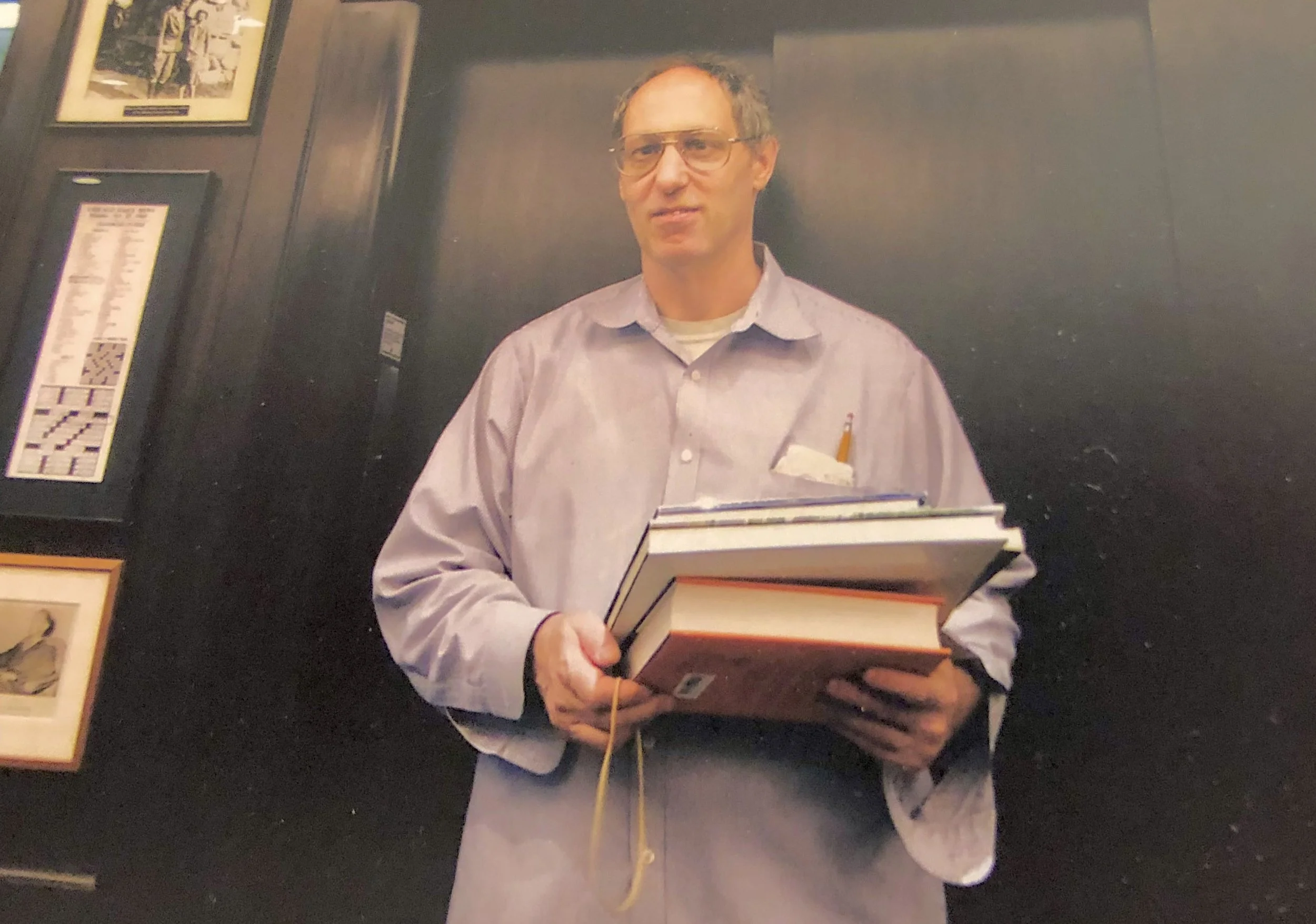
Erik La Prade has a B.A. and M.A. in English Comparative Literature from City College, New York. His work has been published in Ursula, Art in America, BOMB magazine; ArtCritical, WhiteHot Magazine, and other journals. His book, Breaking Through: Richard Bellamy and the Green Gallery, 1960–1965, was published in 2010. Search for Survivors, published in 2025, is his current collection of poetry.