High on Rose, by Jeff Weddle
Review by Peter Mladinic
High on Rose is a bar; it’s where the poems begin, and it comes in toward the end of this book by a poet of fierce independence, who eschews labels, loves language, and, loving freedom, does not write with a censor in his head. Responsive to the forces that seek to erode the freedom of the individual by propagating “group think” and abolishing human rights, Jeff Weddle makes readers aware of what we as a human race have, of what we are losing, and all we could lose. Yet, if seeing things clearly is of value, he is much more optimistic than pessimistic. What comes through more than anything else in this book (from Keeping the Flame Alive Press, 2026) is personality. The personality of a speaker who says no to tyranny and hypocrisy, who longs for things lost, and whose strength lies in his vulnerability. “My life is valuable, and so is yours,” he seems to be saying in every poem.
To say no to tyranny and hypocrisy, a person must be aware of its existence and feel its effects. It is not paranoia but insightfulness that leads the speaker to say, “There are armies all around / and they are searching for you.” Implicit in this statement is an identification with those who the armies are searching for, those who are deemed aliens, and those who are prone to say they’ve no right to be here. The armies are recruiting. They will:
burn your books,
shit on great works of art.
They don’t give a fuck.
There are soldiers in the shadows
and in plain sight.
Each one has it in for you, personally,
though you could be anyone.
They want your mind.
Further into the poem the phrase “fall in love with terror,” coming after this angry (“fuck”) and emphatic (“personally”) passage, suggests the gravity of these armies and their rulers. Silence is unacceptable; say no. The alternative is to let fascism take over. “The rich have bought a president / who is insane / and filled with a gnawing hunger / and his cult is also famished.” The cult, built on hypocrisy, distorts the notion of God and weaponizes religion. To counter the cult’s lies, there is a poem about God, Frank, and the hungry child. God and Frank kill a hog, and all three eat it, but “the child remained hungry,” a revitalization of the notion of God. God did not sate the child’s hunger, but Frank, with God at his side, tried to.
While the poet despairs about “our times,” his longing for things lost is not despair but nostalgia. Weddle is exacting in his evocation of people, places, and things of the past, his recounting of times good and bad, and of times bittersweet. Memory is fallible, yet implicit in the freedom of an individual is the freedom to remember.
It had rained and water beaded
on the tabletops and on the ironwork railing.
This is what I did: I put my hand
on the railing,
the railing painted a deep green,
and I kept it there.
I held tight and felt the hard metal,
the water, and told myself
in this way I could always will my return
to this place and this moment.
Not in memory
but through a hard and personal magic.
He addresses the longings and memories of others succinctly in “The Deeds Were Done,” one of several homages to Weddle’s poetic predecessors. “Everyone’s life / is in a poem / by Richard Brautigan, but which one / is a mystery.” Following up on “mystery” and the inclusion of others, Weddle says “the holy places here / are the road and the roadside attractions— / the world’s biggest this or that— / and especially the insides of cars / heading out to parts unknown / with a couple of friends.”
Weddle’s strength lies his vulnerability. He’s “only human.” Like his poetic predecessor Charles Bukowski, he feels the saddest thing is “not dying” but “being lost.” He says of Bukowski, “Maybe he knew about love. / He for sure knew about screaming.” Allen Ginsberg, in “Howl,” his response to the times, knows it, too. And so does Jeff Weddle, living and writing in “our times,” when silence means complacency. What sane person today wouldn’t scream and rise up in anger, he seems to ask. Intrinsic in his strength to rise is his empathy. “Art” begins “Behind that door / there is a man who is sad / but trying.” Further into the poem “he had not quit.” This man is not the poet, but the poet’s creation. The poet empathizes with the man’s plight in a society that is indifferent to all his efforts. Others the poet has created come forward to make their presence known.
This is for the sad old woman
on the stoop
and the stray dog
walking into traffic.
It’s for the hungry girl mocked
by her pampered classmates
and for the broken drunk
who can’t get a bottle.
This is for the visionary
whose eyes have been plucked,
the elderly man who did everything right
and still can’t afford to live,
the raped child made to give birth.
It is for the parent silent
beside the new grave
and for the darkness inside the casket.
Satire is one outlet for the poet’s anger and sadness over tyranny. “The Lord knows we are very special, / since nobody knows more / about God and guns / than we do.” Satire is sustained as he says, “Madness is always the goal / and we oblige. / Only the mad would let children starve / or let anyone / sleep on the street.” But also, his strength lies in his hope.“When I die / let it be / in an America / that is kind.” Poems of affection and kindness are threaded through Weddle’s poetic journey. His wife, Jill, is at his side, and close by is their daughter Harper, whose artwork is on the cover of these poems written by a thinking, feeling human being.
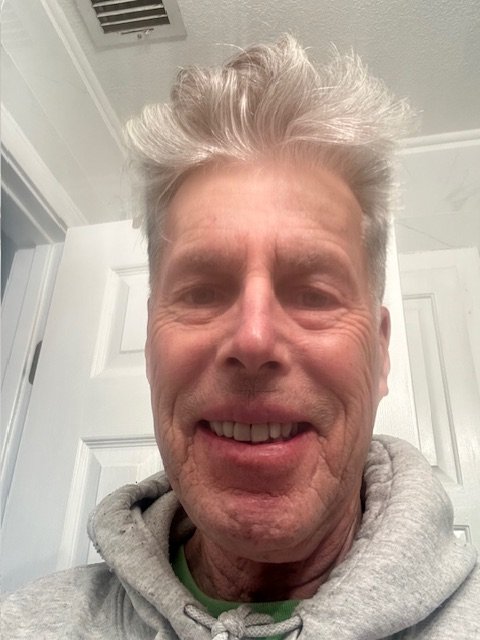
Peter Mladinic's most recent book of poems, The Whitestone Bridge, is available from Anxiety Press. An animal-rights advocate, he lives in Hobbs, New Mexico.